February 2022

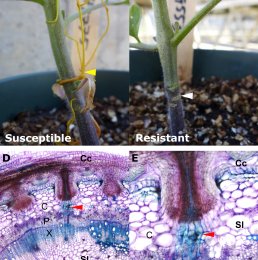
The defence mechanism used by some specific resistant Heinz tomato hybrid cultivars to the destructive parasitic plant Cuscuta campestris, known as field dodders, has been discovered by Min-Yao Jhu, who is currently based at the Crop Science Centre, and her colleagues at UC Davis Sinha Lab.
Published at the end of January in the journal Plant Physiology, this research could provide a foundation for investigating multilayer resistance against Cuscuta species. The study also has the potential for application in other essential crops attacked by parasitic plants.
Lead author Dr. Min-Yao Jhu said “We discovered that the stem cortex in these resistant tomato cultivars responds with local lignification upon C. campestris attachment, preventing parasite entry into the host. We also identified four regulators that confer host resistance by regulating lignification.”
News
May 2026
Cambridge plant scientists elected as Fellows of the Royal Society 2026

News
May 2026
Cambridge Plant Sciences hosts ASPIRE-GreenTE network event

News
May 2026
Naturally occurring soil fungi could boost rice yields while reducing reliance on synthetic fertilisers

News
May 2026
Can we feed the world without breaking the planet?

News
April 2026
NAS honours Professor Uta Paszkowski at official signing ceremony

News
March 2026
Hacking for hunger: global scientists gather in Accra to code climate-resilient crops

News
March 2026
CEO Professor Mario Caccamo leaving Niab

News
February 2026
Global experts meet in Cambridge to advance the future of the Bambara groundnut

News
February 2026
How genebanks helped Ahmed bring back cowpea to Somalia

News
February 2026
How I’m helping rice farmers in India harness the power of fungi in the soil

News
November 2025
COP30 film highlights how Crop Science Centre collaborations are empowering farmers through sustainable innovation

News
October 2025
Professor Uta Paszkowski appointed co-Director of ENSA in new joint leadership to accelerate breakthrough crop science for smallholder farmers